Butrint National Park: Albania's UNESCO Ancient City
Butrint is a UNESCO ancient city near Saranda and Ksamil - its theatre, mosaics, Venetian tower and how to visit on a day trip.
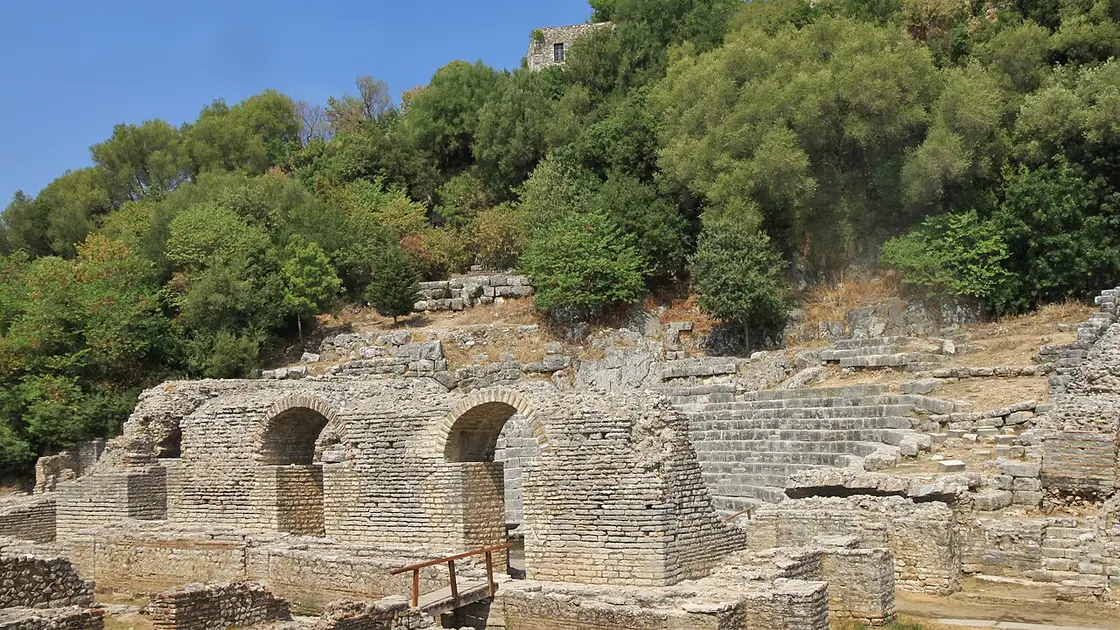
Butrint (Butrinti) is a UNESCO World Heritage ancient city on a wooded peninsula in southern Albania, about 18 km south of Saranda and a few minutes’ drive past Ksamil. It’s one of the Mediterranean’s most complete archaeological sites - a single walkable park that stacks Greek, Roman, Byzantine, Venetian and Ottoman ruins above a lagoon, with a Greek theatre, an early-Christian baptistery floored in mosaics, a hilltop acropolis and a Venetian tower all linked by a shaded loop trail.
The thing to know up front is that Butrint is one easy loop, not a sprawl: a single shaded trail links the Greek theatre, the mosaic baptistery, the acropolis and the Venetian tower above the lagoon. It sits so close to the Blue Eye spring and Ksamil that most people roll all three into one day out of Saranda.
What is Butrint?
Butrint is the archaeological heart of Butrint National Park, a protected wetland and forest of roughly 90 km² at the southern tip of the Albanian coast, facing the Greek island of Corfu across a narrow strait. The ruins sit on a low peninsula between Lake Butrint and the Vivari Channel, the short waterway that drains the lagoon to the Ionian Sea. The setting is as much a draw as the stones: oak and laurel woods, reed beds, water on three sides, and birdsong instead of crowds for most of the year.
The site was inscribed on the UNESCO World Heritage List in 1992, with the listing later extended, and it’s also a Ramsar wetland of international importance. What makes it special is continuity - rather than one civilisation, you walk through a city that was occupied for well over two thousand years and abandoned only when the marsh and malaria finally won out. The view from the fortress over the Vivari Channel toward the lagoon and Corfu (pictured in the gallery below) is half the appeal.
A short history: Greeks, Romans, Venetians
Butrint’s appeal is its layers, so you’ll want the broad sweep before you walk the loop.
- Greek (from around the 7th-4th centuries BC). The earliest substantial city was a Greek settlement, Bouthroton, with a sanctuary to the healing god Asclepius on the slope below the acropolis. The famous Greek theatre was built here, and inscriptions carved into its stone - including records of freed slaves - still survive.
- Roman. After Rome’s expansion the city became a Roman colony, prospering as a port. The Romans enlarged the theatre, laid out a forum, and built baths, houses and an aqueduct; much of the masonry you see threading the woods is Roman.
- Byzantine / early-Christian. In late antiquity Butrint became a bishopric, and its Christians built a basilica and a circular baptistery with one of the finest surviving mosaic floors in the region.
- Venetian and Ottoman. From the medieval period the lagoon was contested between Venice and the Ottomans. The Venetians fortified the site, raising a triangular castle and the square tower that still guards the channel; across the water sits the later Ottoman fort linked to Ali Pasha of Ioannina.
By the time European travellers and, in the 20th century, archaeologists rediscovered Butrint, the marsh had reclaimed much of the lower city - which is exactly why so much survived to be excavated - that’s the irony of the marsh.
What to see at Butrint
A signposted loop trail links the monuments through the trees; following it in order is the easy way to see everything without backtracking - don’t invent your own route. Below are the highlights, roughly in the sequence most people walk them.
The Greek and Roman theatre
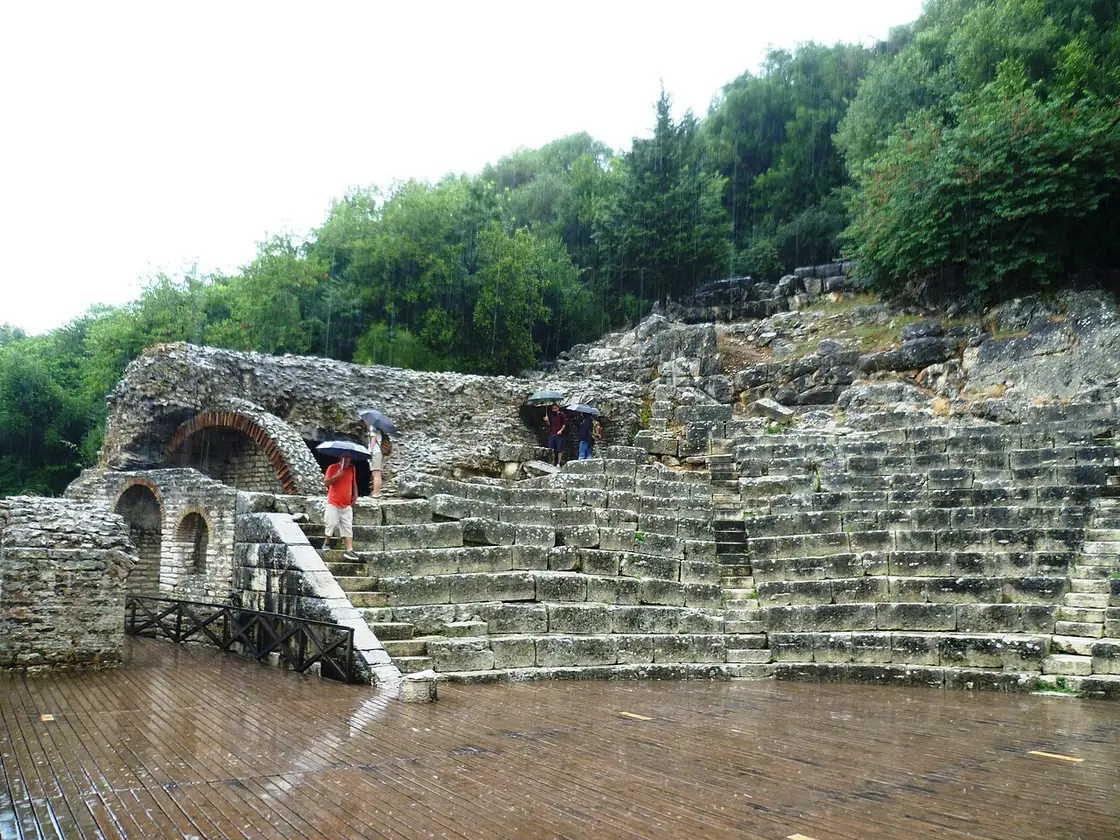
The theatre is the showpiece and usually the first major monument on the loop. Begun by the Greeks in the 3rd century BC and reworked by the Romans, its curved stone seating is tucked into the hillside below the acropolis, beside the sanctuary of Asclepius. You’ll want to look for the Greek inscriptions cut into the stonework. The bowl sits low and often holds a little water after rain, which mirrors the tiers - a favourite photo.
The baptistery and its mosaics
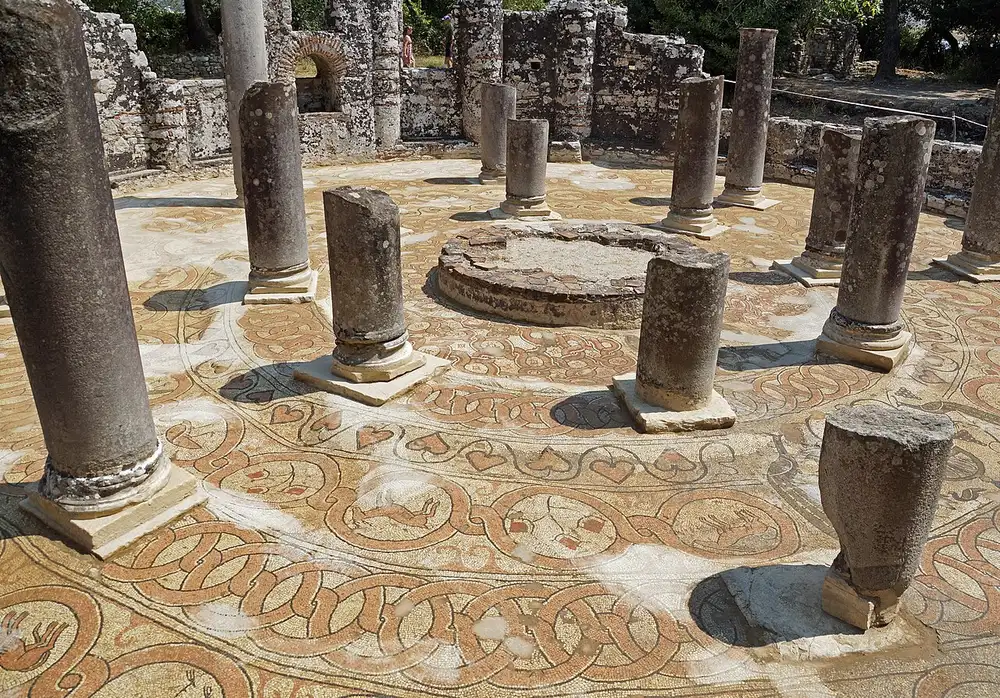
A short way on stands the baptistery, a round early-Christian building from the 6th century whose floor is paved with an exceptional mosaic of animals, birds and geometric medallions ringed by columns. Because the mosaic is fragile, it’s usually kept covered with protective sand or gravel and only uncovered on special occasions - so don’t be surprised if you find it sheeted over rather than on full display. Even covered, the ring of columns and the scale of the rotunda are striking, and good reproductions are shown at the site museum.
The Lion Gate and city walls
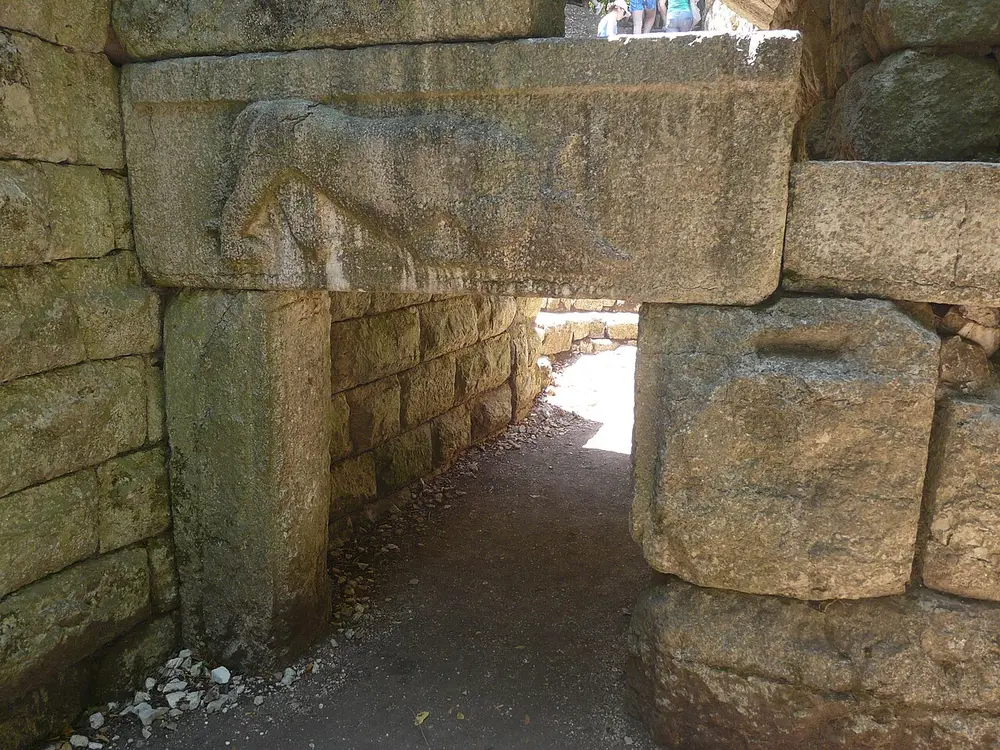
Threaded along the old defensive circuit are several ancient gates. The best known is the Lion Gate, named for the worn stone relief above it showing a lion devouring the head of a bull. The carving is older than the gate itself: the lintel was lowered in late antiquity to make the entrance smaller and easier to defend, reusing an earlier sculpted block. Nearby, the cyclopean Scaean Gate shows off the massive unmortared blocks of the earliest Greek walls.
The acropolis and museum
The path climbs to the acropolis at the top of the hill, the city’s oldest core and now the site of a small museum housed in the Venetian-era castle. It’s worth the short climb twice over: the displays gather statues, inscriptions and finds from the digs, and the terrace gives the best panorama over the whole peninsula - the theatre below, the woods, the channel and the lagoon stretching toward Corfu.
The Venetian tower and the channel
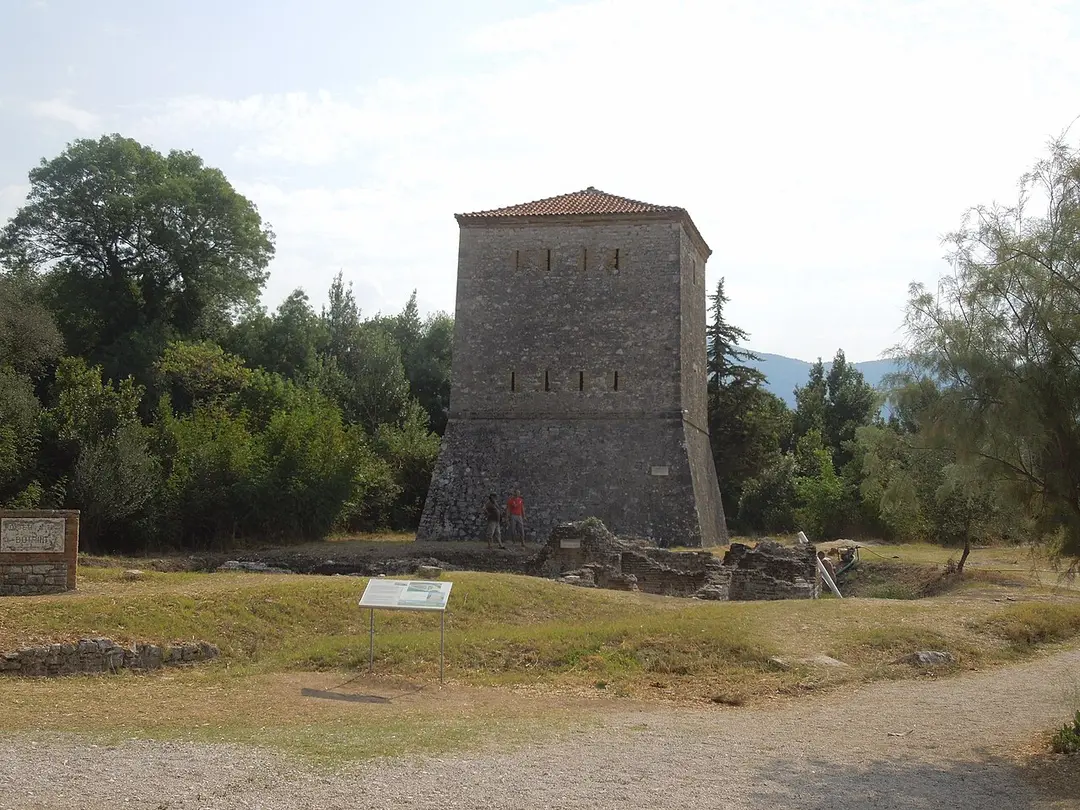
Down at the water’s edge, guarding the Vivari Channel, stands the square Venetian tower and the triangular castle the Venetians built to control the strait and its prized fishing. From here a tiny cable ferry still crosses the channel; on the far bank sits the later Ali Pasha fort. It’s the quietest, most atmospheric corner of the park, and the natural place to end the loop before heading back.
How to get to Butrint
Butrint sits at the very end of the coastal road south of Saranda, past Ksamil - the road literally stops at the ticket gate, so it’s hard to miss.
| Route | Roughly | Notes |
|---|---|---|
| Saranda → Butrint (bus) | ~30-40 min | The local Saranda-Butrint bus runs along the seafront and down through Ksamil to the gate; cheap and frequent in summer. |
| Saranda → Butrint (car/taxi) | ~18 km / ~25-30 min | Straightforward drive south through Ksamil; a taxi or rental car gives the most flexibility for combining stops. |
| Ksamil → Butrint | ~4 km / ~10 min | Butrint is just past Ksamil on the same road - easy to pair with a beach morning. |
| Tirana → Butrint | ~300 km / ~5 h | A long way for a day trip; almost everyone bases in Saranda and visits from there. |
The easiest approach is from Saranda, the southern coast’s main hub and the base most travellers use for the whole area. The local bus to Butrint leaves from the Saranda seafront and runs down through Ksamil to the gate; in summer it goes roughly every hour, though timings thin out off-season - check locally the day before. A taxi or a rental car is quicker and lets you fold in the Blue Eye or a Ksamil swim on the same loop. Many visitors simply take an organised day trip that bundles Butrint with the Blue Eye and Ksamil and handles the driving.
If you’re driving the south yourself, our guide to renting a car in Albania covers costs and insurance, and Butrint is a fixed stop on our Albania road-trip itinerary. Coming from Greece, the Saranda to Corfu ferry puts you 18 km from the gate: an early boat gets you to Butrint before the tour buses. Staying on Corfu? Our Butrint day trip from Corfu lines up the boats with the site’s opening hours, season by season.
Tickets, opening hours and how long to allow
Butrint has a staffed ticket gate, and the tariff is published on the national cultural-sites ticketing platform: a standard adult ticket is 1,000 lek, falling to 800 lek a head for groups of ten or more (culturalsites.myticket.al, re-checked 24 August 2026). It’s the same 1,000 and 800 lek the culture ministry set in its January 2020 tariff, and the platform showed the same in June 2025. Opening runs 08:30 to 20:00 from 1 April to 31 October, with last entry at 18:00, and 09:00 to 17:30 the rest of the year, last entry 15:00. A handful of 2026 blogs still print 700 lek, which is out of date - carry a bit more cash than they suggest, and check the board at the gate, because the park does move both the price and the hours.
A few practical pointers that don’t change:
- How long to allow. Plan for two to three hours to walk the full loop without rushing; keen visitors and photographers happily spend longer.
- When to go. In July and August come early or late to beat both the heat and the tour-bus crush around midday; spring and autumn are ideal, with green woods and mild light.
- What to bring. Water, a hat and proper shoes - the trail is uneven stone and tree roots, and there’s little shade in the open lower city. There’s a café near the entrance.
- Guides and museum. A guide or a good audio guide adds a lot, because the ruins aren’t always heavily labelled; don’t skip the museum in the acropolis castle.
Combining Butrint with the Blue Eye and Ksamil
Butrint’s location makes it easy to chain with the other two headline sights of the far south, and most people do exactly that.
- Ksamil is only about 4 km back up the road, so the classic plan is a beach morning at Ksamil - swimming out to its little offshore islets - followed by an afternoon at Butrint when the light softens and the crowds thin. Our Saranda travel guide covers Ksamil and the town beaches in detail.
- The Blue Eye (Syri i Kaltër), the vivid karst spring inland from Saranda, sits on a different road, so pairing it with Butrint means a bit more driving - easiest with a car or on an organised tour that loops both. If you only have a car for one day, doing Butrint plus Ksamil is the tighter, more relaxed combination, with the Blue Eye on a separate half-day toward Gjirokastër.
- For the whole menu - six trips out of Saranda with distances, bus fares and which ones pair up - see our guide to the best day trips from Saranda.
However you slice it, Saranda is the sensible base for all three - see the Saranda guide for where to stay and how the day trips fit together, and browse more Albanian attractions for the rest of the south.
Why Butrint is worth it
Plenty of Mediterranean ruins are grander or busier, but few let you walk from a Greek theatre to a Roman forum, a Byzantine baptistery and a Venetian castle in a single shaded hour by the water. Add the wetland setting, the rarity of real quiet at a UNESCO site, and how easily it slots between a Ksamil swim and a Saranda sunset, and Butrint earns its place as the cultural anchor of any southern-Albania trip. If it leaves you wanting more of Albania’s classical past, the ruins of Apollonia near Fier are the other great ancient city, an easy stop on the drive back north.
What’s nearby and read also
- Base yourself nearby - see our Saranda travel guide for beaches, the Blue Eye and Ksamil.
- Driving the south? Read how to rent a car in Albania.
- Fit Butrint into a bigger loop with the Albania road-trip itinerary.
- Pair it with Berat and Gjirokaster on the UNESCO Albania route.
- Browse more Albanian attractions for your next stop.
Photos
On the map
The map loads on click - to keep the page lightweight.
The map didn’t load. Check your connection and refresh the page.
Distance ≈300 km · ~5 h by road
- Tirana ≈300 km · ~5 h by road Most visitors reach Butrint from Saranda (~18 km south); from Tirana it is a long day, better split with an overnight in Saranda.
Read also

What to see · 12 min read
House of Leaves Tirana: 700 Lek, Hours, What's Inside
Updated · October 2, 2026Tirana's secret-police museum: 700 lek (about €7.60), cash only, daily 09:00-19:00 in summer, shut on winter Mondays. What's in its 31 rooms.

What to see · 9 min read
Bovilla Lake Tirana: Gamti Viewpoint & Road Tips
Updated · September 1, 2026Bovilla Lake near Tirana: 20 km by road, gravel last stretch, Gamti balcony hike, drinking-water rules, and when a guided tour beats self-drive.

What to see · 11 min read
Valbona Valley: Guesthouses, Walks & Alpine Road
Updated · August 30, 2026Valbona Valley in the Albanian Alps: arrival via Fierza and Bajram Curri, guesthouses, short walks, and the paved Alpine road.

What to see · 9 min read
Shala River Day Trip: Albania's Alpine 'Thailand'
Updated · August 27, 2026Shala River day trip in 2026: turquoise water in the Albanian Alps, boat times from Koman Lake, prices, what to pack, and how it differs from the ferry.