Porto Palermo Castle Albania: 300 Lek, Hours, Ali Pasha
Porto Palermo, 10 km south of Himara: 300 lek to walk Ali Pasha's triangular fortress, summer hours 09:00-19:00, and how to get there without a car.
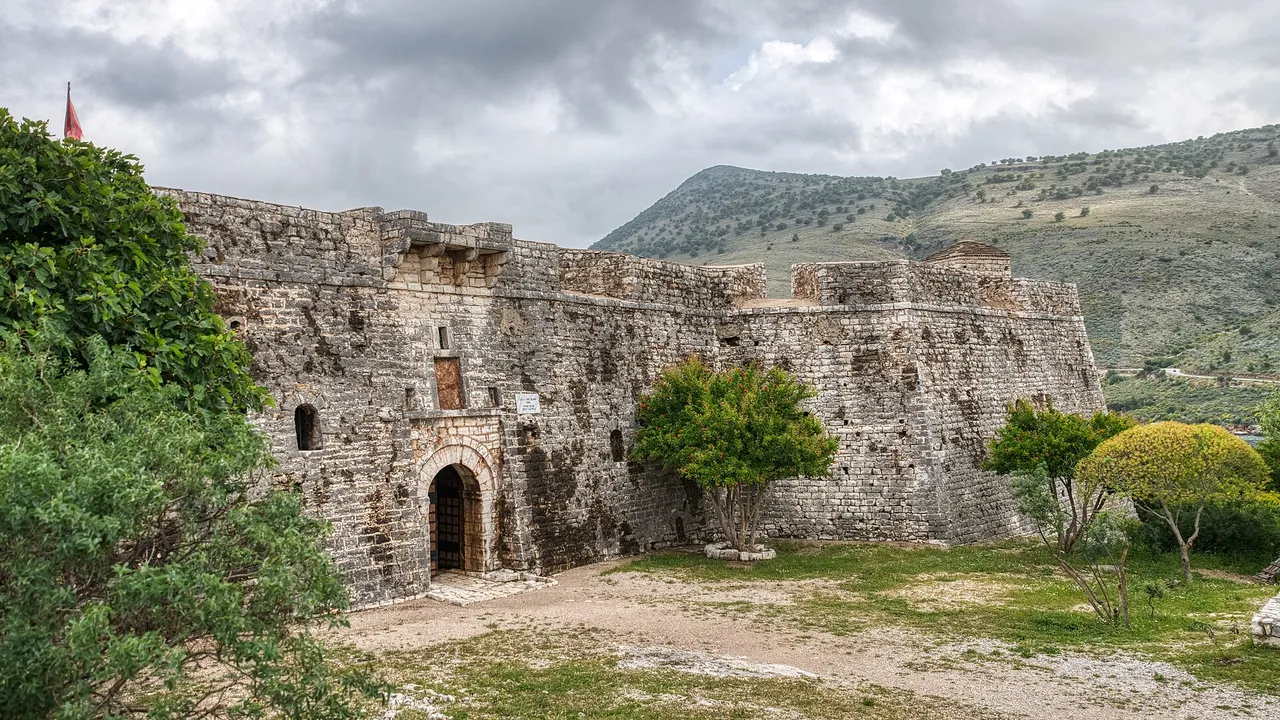
Porto Palermo is a near-enclosed bay about 10 km south of Himara, with a triangular stone fortress on the southern point of its entrance, joined to the shore by a low isthmus. The castle costs 300 lek a head, roughly EUR 3.20 or USD 3.69, paid in lek at the gate, and through the summer it’s open 09:00 to 19:00, seven days a week. An hour covers the walls. Half a day covers the walls and a swim.
Plenty of people park, look at a blunt stone triangle, photograph the bay and leave puzzled by the fuss. What they’ve walked past is an artillery fort from the Napoleonic wars whose builder is still argued over, a bay that spent two decades as a closed naval station, and water protected as a Natural Park since 2022. Euronews Albania counted around 100 visitors a day here in August 2024, mostly foreigners. On this coast in August, that is empty.
Three layers on one headland
The castle doesn’t sit on a real island: it sits on what was one, until landfill tied it to the shore, so you walk out along a low neck of land instead of taking a boat. That neck made the spot worth fortifying: a gun position on the southern point of the entrance to a deep, sheltered anchorage.
Ali Pasha of Tepelena, who ran Epirus and much of southern Albania from Ioannina in the early 19th century, is the name on the sign, and a study of his pashalik’s fortress network calls this his best-preserved garrison in the region. Fort, naval base and Natural Park sit within a kilometre and a half of each other.
Getting there, and whether you need a car
| From | Road distance | Driving time |
|---|---|---|
| Himara | 10 km | ~20 min |
| Saranda | 45 km | ~1 h |
| Vlora | 70 km | ~1 h 45 |
| Tirana | 226 km | ~4 h |
Those are road distances from OpenStreetMap routing, not straight lines. One worth correcting: Porto Palermo is 45 km from Saranda, not the 55 km often quoted - the 55 belongs to Himara, one bay north.
You come off the SH8 and drop towards the water. There’s no bus to the gate. What exists is the Saranda to Himara service, roughly seven runs a day at 700 to 900 lek end to end - no operator publishes a fixed fare, so confirm it locally - and drivers will let you off at the Porto Palermo junction if you ask. From there down to the castle is about a kilometre on foot, fifteen minutes, downhill. Coming back it is uphill, in the afternoon, with no shade, waiting for a bus on no published timetable. Sort out the return before you walk down.
The other way in is by water. Speedboats work this stretch out of Himara’s main beach, twenty minutes up the coast: the southbound run is about 2.5 hours at EUR 25 to 30 a head in a group, EUR 160 to 300 private, morning or late afternoon. Read the itinerary first. On the operators’ own listings the castle is a five-minute photo stop; the hours go on swim stops, the coves either side and a look at the submarine tunnel from the water. A boat buys the view of the fort, not a ticket into it - for the walls and the roof terrace you still arrive by road.
So: a driving stop, a boat stop, or a hot walk with a plan. Renting a car in Albania covers the real costs and insurance traps; getting around Albania covers buses and furgons.
Tickets, hours and the days it’s free
The Regional Directorate of Cultural Heritage in Vlora runs the ticket office and, unlike many Albanian sites, publishes its rates. A nationwide tariff reform in September 2025 doubled the entry fee at some other state-run sites (Apollonia went from 300 to 600 lek), so this figure is worth re-checking on principle - re-verified 24 August 2026, and unchanged since at least March 2025:
- Individual ticket: 300 lek per person - EUR 3.20 or USD 3.69 at the Bank of Albania’s rate that day (93.53 to the euro, 81.28 to the dollar)
- Groups: 200 lek per person
- Children under 12: free
- Reduced: students with a card, 12 to 18s, pensioners and people with disabilities - the amount isn’t published
Hours are 09:00 to 19:00 daily in the summer season. Out of season the castle closes Mondays and runs 09:00 to 16:00 Tuesday to Saturday, 09:00 to 14:00 Sunday. Nobody publishes where summer starts and ends, so in May or October accept the risk of a short day or a closed gate.
Read the free days closely, because half of them aren’t for you. 18 April, 18 May, 21 May and 29 September are open to everyone. 28 and 29 November, and the last Sunday of every month, are free for Albanian citizens only. Bring lek either way. The charge is recent: Robert Hackman, a British photojournalist filming here in 2024, noted the castle had been free for years. Treat it as a maintenance fee, not a revenue stream.
What you walk through
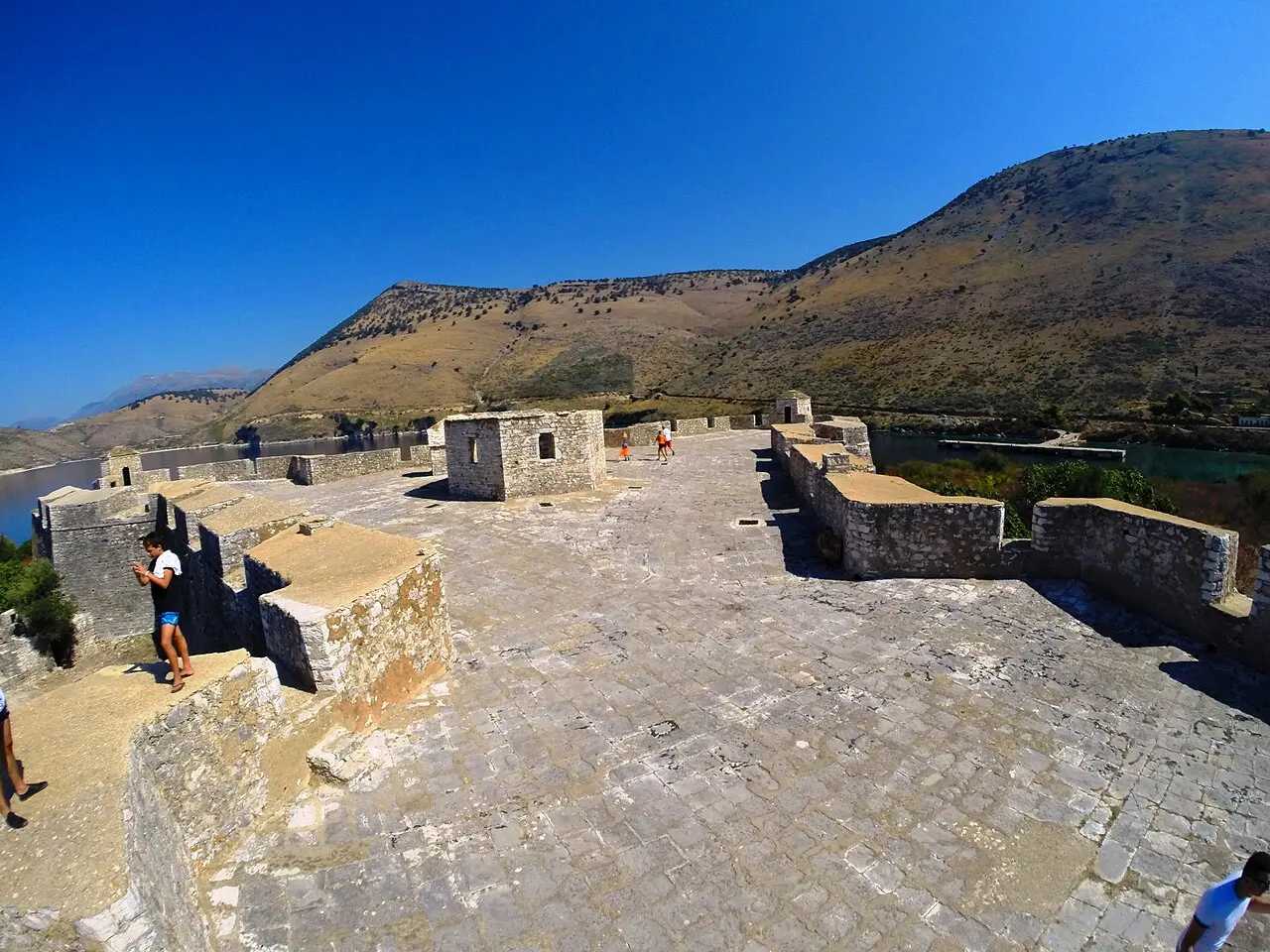
The plan is unusual enough to notice: a three-sided fort with three heavy gun bastions at the corners and a terrace open to the south. Inside, a hexagonal central chamber under a domed ceiling, carried on six pillars, opens onto everything else - the rectangular rooms where the garrison lived, the stairs, the terraces.
There’s no lighting inside. Mal Berisha, in an October 2025 opinion piece, was still asking the Ministry of Culture and Himara municipality to fund some, along with a proper restoration - bring a phone torch for the side chambers. The roof is the reward: bare warm stone, the bay on three sides, the Ceraunian slopes going brown behind you, and an instant answer to why somebody put a fort here.
Who really built it
Here’s where the guidebooks quietly disagree. The standard account, backed by the archaeological literature, is that Ali Pasha built the fort in the early 19th century; an inscription over the entrance dated it to 1804, to a design by French engineers, though that stone is gone. The German archaeological guide most often cited, Zindel, Lippert, Lahi and Kiel (2018), adds that it’s unlikely any Venetian or Ottoman work stood here beforehand.
The counter-argument is Hackman’s, and it’s geometric rather than romantic. The triangular plan is close to the Venetian fortress at Butrint, built around 1500. The hills behind overlook the castle completely, so anyone with field guns on that ridge owns the fort - a strange thing for a land power to build. And the Venetians were already worrying in 1662 about the Ottomans taking a fortress here and using it against Corfu, whose nearest cape is 30 km down the channel. On that reading, Ali Pasha renovated something older.
The documents lean one way and the stones lean the other, and nobody has settled it. What the record shows is how little Ali Pasha thought of the place: in 1803 he offered the castle and its port to the Royal Navy, when it mounted four or five guns, and William Martin Leake found a garrison of ten men with two four-pounders. Pouqueville, writing in 1806, gets the shape wrong in a way that suggests he worked from memory - “a square with bastions” - and dismissed it as “of no service either to command the entrance or to protect the shipping at anchor”.
Vasiliqi, and the story you’ll hear at the gate
The Albanian press sells this as a love story: Ali Pasha built the castle as a gift for Vasiliqi, the young Orthodox Christian wife he adored, which is why you’ll see it called Kalaja e Vasiliqisë as often as Kalaja e Porto Palermos. A French visitor filmed here by Euronews Albania in 2024 said he’d read the information panel and come away knowing the castle “was built for love”. Worth noticing: the national tourism agency’s own page doesn’t say it, crediting Ali Pasha in the early 19th century and stopping there.
The bones of it are real. She was a Christian, decades younger than him, and unusually for a ruler in his position he let her practise openly and keep a chapel. Whether any of that produced this fortress is another matter. A small white chapel does stand on the shore below the walls and people call it hers, but nothing official ties the building to her, and the Greek church Pouqueville recorded beside the fort in 1806 may or may not be it. Enjoy the story, don’t repeat it as history.
The half of the bay you can’t visit
At the northern end of the bay there’s a squared-off opening in the rock: the Porto Palermo tunnel, cut for the navy from 1969 and in use until 1991. It’s usually called a submarine pen online, with dimensions that vary wildly from blog to blog and none of them sourced, so treat any figure you read with suspicion. The duller version is more likely: its main job was sheltering fast attack craft, because Albania’s Whiskey-class submarines were long-range boats normally kept at Pashaliman in Vlora bay.
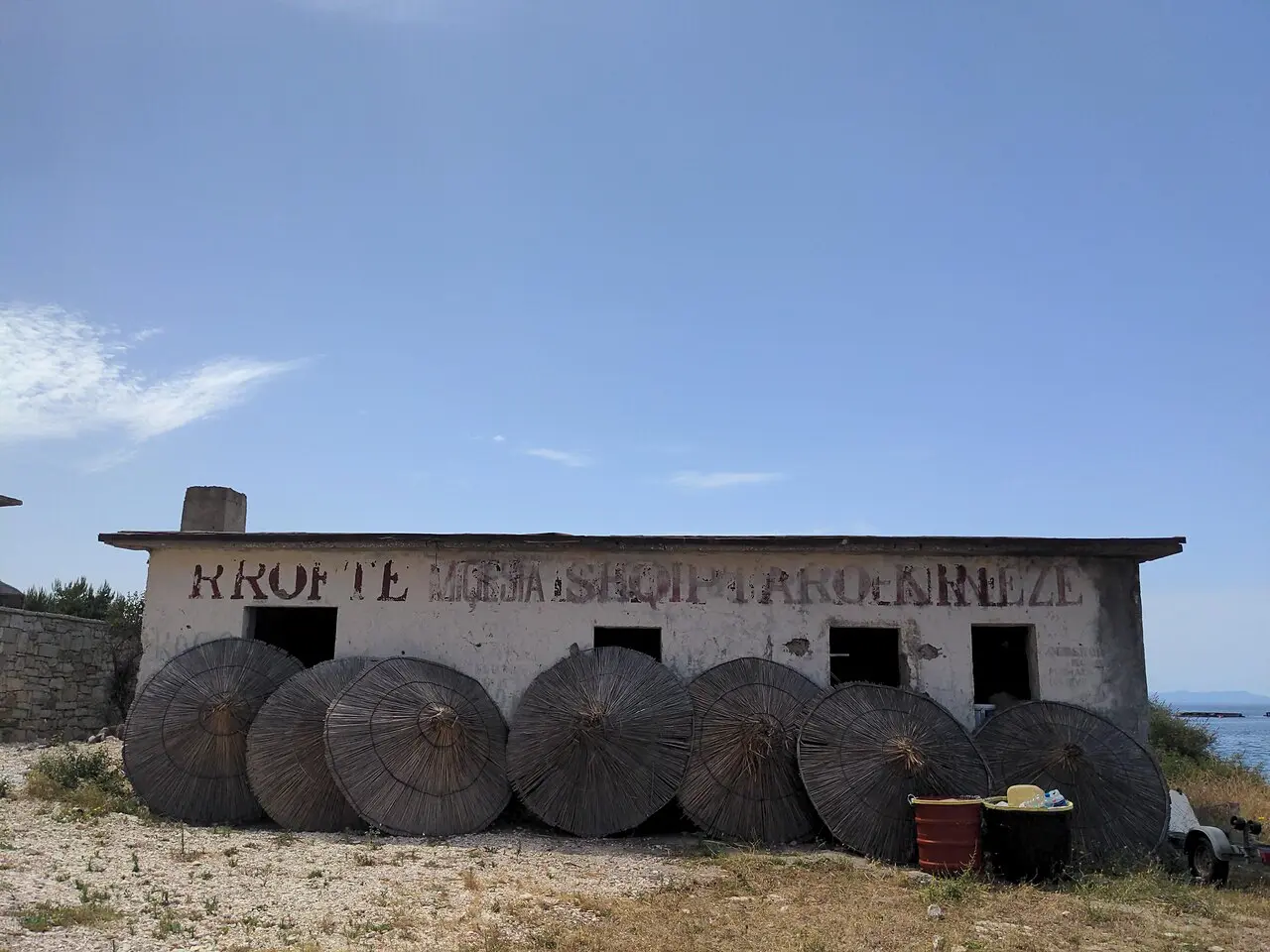
More to the point, it’s still a military zone and not open. Look from the road or a passing boat. The naval past is easy to find anyway: the shore is dotted with abandoned blockhouses, one still carrying RROFTË MIQËSIA SHQIPTARO-KINEZE, long live Albanian-Chinese friendship, from the years when Beijing was Tirana’s last ally.
Swimming in a protected bay
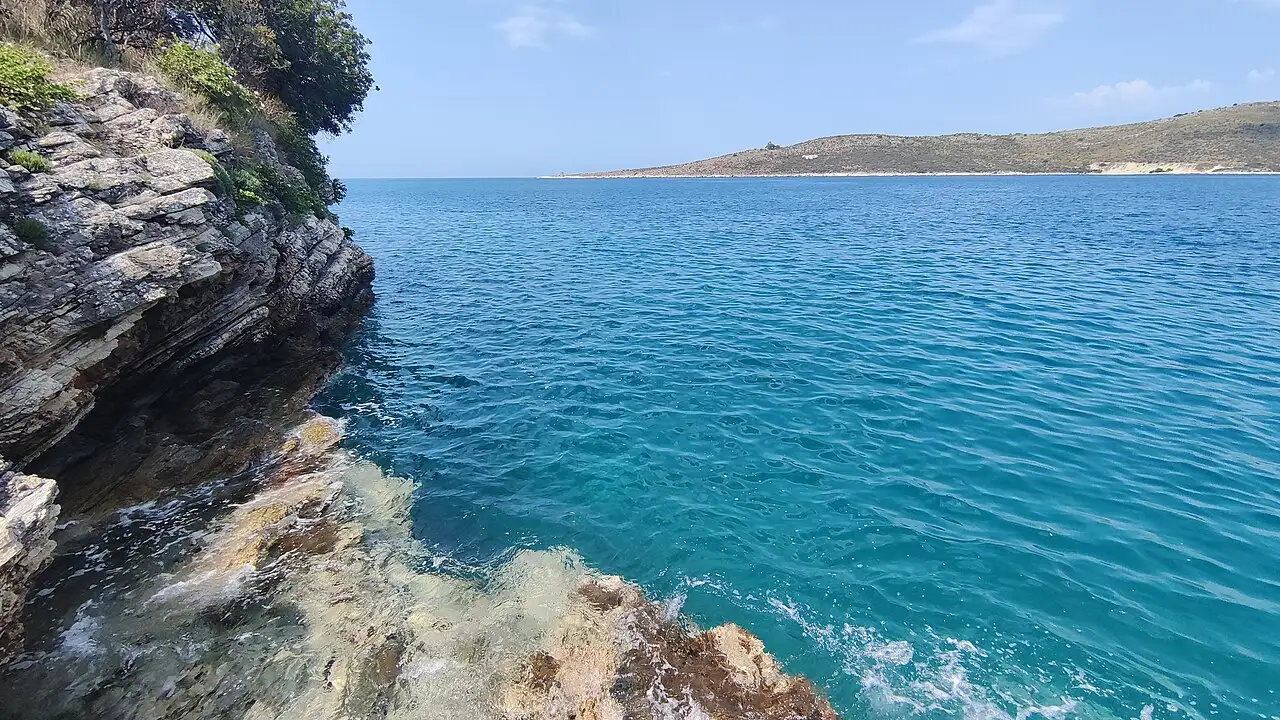
The bay is sheltered on three sides, so it stays flatter than the open Riviera coves when the wind gets up, and the water off the rocks is deep and clear. It isn’t a sunbed strip and there’s no run of beach bars, which is exactly what its regulars want. In our ranking of Albanian beaches it comes eighth, scoring on cost and crowds rather than comfort.
What almost nobody mentions is the legal status. By Council of Ministers decision no. 557 of 29 July 2022 the bay became the Porto Palermo Natural Park, IUCN category IV: 1,694.98 hectares, 88 percent of it marine, zoned into core, traditional-use and recreational areas. The reason is under the surface: Posidonia oceanica, the seagrass whose meadows are among the most valuable habitats in this sea, grows here in quantity. If you snorkel, the dark patches are the point. Stricter protection sits up the coast at Karaburun-Sazan, the country’s only marine national park; this bay is a lower category and far less visited.
There’s a live argument attached. A 2025 investigation citing the state audit office described a March 2022 proposal from the Albanian Investment Corporation, “Porto Palermo Marina Resort”: yacht moorings, five-star hotels, the naval tunnels turned into museums. As of August 2026 it is paper: no permits reported, nothing built. The same investigation notes the adopted park boundary left the former military land outside strict protection. If you want this bay scruffy and half-abandoned, that isn’t guaranteed forever.
How long you need, and what to pair it with
For most people it’s a 60 to 90 minute stop: park, walk the neck of land, do the walls and the roof. Add swimming gear and it becomes three or four hours, which is the version I’d argue for - the swim is at least half of what makes the place. Go in the morning: better light on the walls, calmer sea before the wind fills in.
Pair it with Himara, twenty minutes up the coast and the most sensible base for this end of the Riviera. From the south it slots into a run north from Saranda, costed out in day trips from Saranda. For the coast either side, start with the Albanian Riviera guide. And if you’re still choosing months, best time to visit Albania explains why late September beats mid-August here: warm sea, thinner crowd, and 29 September is a free-entry day. Check the hours first - nobody publishes when the summer timetable ends.
Photos
On the map
The map loads on click - to keep the page lightweight.
The map didn’t load. Check your connection and refresh the page.
Admission and opening hours
- Admission price
- Individual ticket 300 lek per person (about EUR 3.20 / USD 3.69), groups 200 lek per person, under-12s free. Reduced rates for students with a card, 12-18s, pensioners and people with disabilities, though the amount is not published.
- Opening hours
- Summer season Mon-Sun 09:00-19:00. Out of season: Monday closed, Tue-Sat 09:00-16:00, Sun 09:00-14:00.
Prices and hours are those published by the Regional Directorate of Cultural Heritage in Vlora, which runs the ticket office, re-verified 24 August 2026 against a March 2025 Wayback snapshot of the same page (unchanged) - so the September 2025 nationwide heritage-tariff reform that doubled some other sites did not reach this one. The directorate does not publish the calendar dates of the summer season or whether the desk takes cards, so carry lek and reconfirm at the gate.
Details checked: August 24, 2026
Distance
- Tirana ≈226 km · ~4 h by road No fast route. South via Vlora and either the Llogara Pass or the tunnel, then the coastal SH8 past Himara. Tirana is the arrival airport.
- Saranda ≈45 km · ~1 h by car The easy approach. Buses on the Saranda-Himara road will drop you at the turn-off, from where it is about a kilometre on foot down to the bay.
Read also

What to see · 9 min read
Bovilla Lake Tirana: Gamti Viewpoint & Road Tips
Updated · September 1, 2026Bovilla Lake near Tirana: 20 km by road, gravel last stretch, Gamti balcony hike, drinking-water rules, and when a guided tour beats self-drive.

What to see · 11 min read
Valbona Valley: Guesthouses, Walks & Alpine Road
Updated · August 30, 2026Valbona Valley in the Albanian Alps: arrival via Fierza and Bajram Curri, guesthouses, short walks, and the paved Alpine road.

What to see · 9 min read
Shala River Day Trip: Albania's Alpine 'Thailand'
Updated · August 27, 2026Shala River day trip in 2026: turquoise water in the Albanian Alps, boat times from Koman Lake, prices, what to pack, and how it differs from the ferry.

What to see · 10 min read
Saranda Boat Trips 2026: Kakome, Krorez & Mirror Beach
Updated · September 17, 2026Saranda boat trips to Kakome, Krorez and Mirror Beach: EUR 25-35 north and from EUR 100 south at the operators we checked, plus where boats leave.