
Tirana to Gjirokaster 2026: Bus 1,200 Lek (~€13), 4h31
Tirana to Gjirokaster (Gjirokastra): 13 coaches a day, 05:00-20:30, from the South and North Terminal; 1,200 lek (~€13), 4h31 on the timetable.
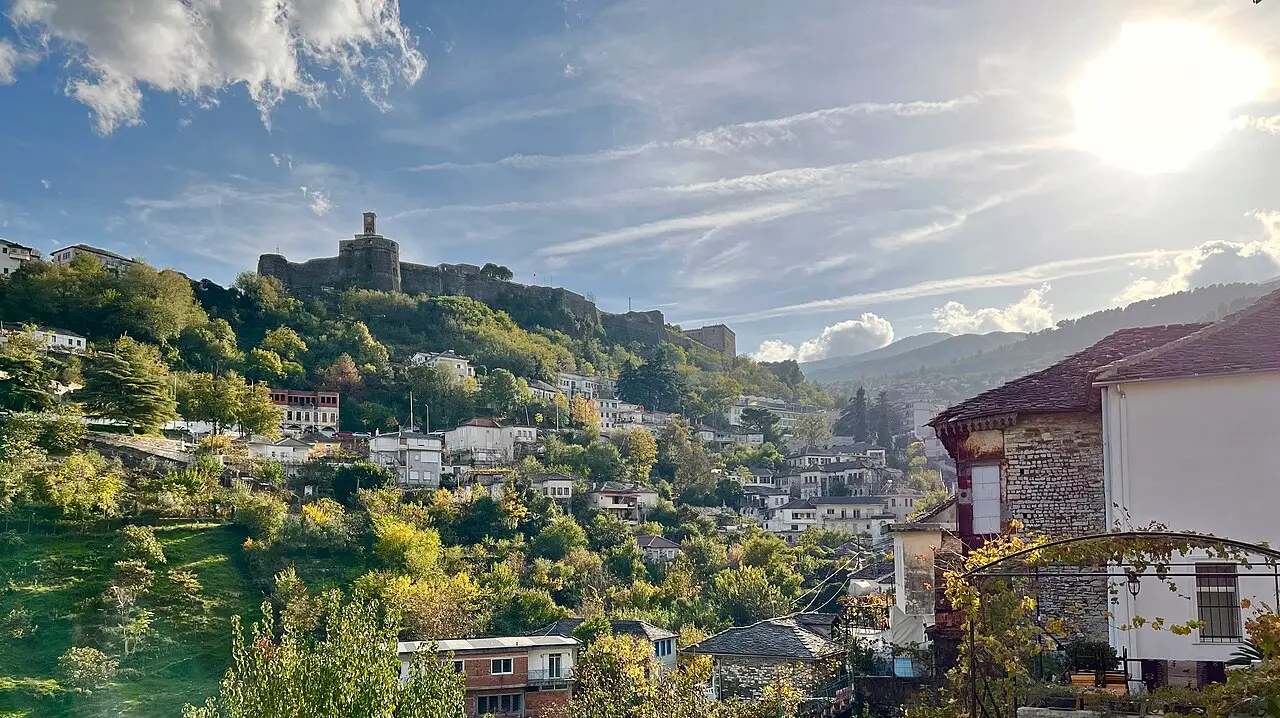
A coach seat from Tirana to Gjirokastër (Gjirokastra) is listed at 1,200 lek, roughly €13, by both companies on the route, and the timetable gives the run 4 hours 31 minutes. There are 13 departures a day from 05:00 to 20:30, split between Tirka 2000 and Argjiro; we checked the fares on the regional tourism portal and the times in the state register of intercity lines on 23 September 2026. All thirteen board at Tirana’s South and North terminal by the Casa Italia overpass, a 6 km taxi ride from Skanderbeg Square. There’s no separate furgon line on the route, no train and no flight.
Pick your coach by the time it arrives, not the time it leaves. On the timetable, the 18:30 is due in Gjirokastër at 23:01 and the 20:30 at one in the morning, while the 05:00 gets you there by 09:31 with the whole day ahead. For most people the 08:00 or the 09:00 is the one to take: you’re in the old town for a late lunch, with the afternoon free for the castle.
Thirteen coaches, hour by hour
All of them run every day of the week. Tirka 2000 has everything up to 10:00 plus the 15:30, and Argjiro has the rest.
| Leaves Tirana | Company | Timetabled arrival |
|---|---|---|
| 05:00 | Tirka 2000 | 09:31 |
| 06:45 | Tirka 2000 | 11:16 |
| 08:00 | Tirka 2000 | 12:31 |
| 09:00 | Tirka 2000 | 13:31 |
| 10:00 | Tirka 2000 | 14:31 |
| 11:00 | Argjiro | 15:31 |
| 12:00 | Argjiro | 16:31 |
| 13:00 | Argjiro | 17:31 |
| 14:30 | Argjiro | 19:01 |
| 15:30 | Tirka 2000 | 20:01 |
| 17:00 | Argjiro | 21:31 |
| 18:30 | Argjiro | 23:01 |
| 20:30 | Argjiro | 01:01 (next day) |
Those departure times match the list the terminal operator, Tirana Parking, publishes for the same line, and Tirana Parking also prints each company’s phone number: Tirka 2000 on +355 69 331 2764, Argjiro on +355 69 453 6700. Tirana municipality’s own terminal page disagrees on two evening coaches, showing 17:30 and 19:30 where the licence has 17:00 and 20:30, so if you’re counting on a late one, call Argjiro the day before.
The return runs the other way round: Argjiro leaves Gjirokastër at 04:00, 05:00, 07:00, 08:00, 09:00, 10:00 and 15:30, and Tirka 2000 at 11:00, 12:00, 13:00, 14:30, 17:00 and 18:30, each timed at 4 hours 28 minutes. The 04:00 reaches Tirana at 08:28, early enough for a late-morning flight; for an afternoon one, the 07:00 (in at 11:28) leaves time for the hourly airport shuttle. Only the licence lists that 04:00, though. Argjiro’s portal listing starts at 05:00, so confirm the early one with Argjiro before you plan around it.
Why the timetable says four and a half hours
The drive itself is shorter. By road it’s about 218 km from Skanderbeg Square to the Gjirokastër stop, 3 hours 26 minutes with no stops at all. The timetable isn’t a stopwatch figure: the state register works out almost every intercity line in Albania at the same average speed of 50 km/h, and 226 km at that pace is 4 hours 31 minutes. Plan on the timetable, not the map, and treat an early arrival as a bonus.
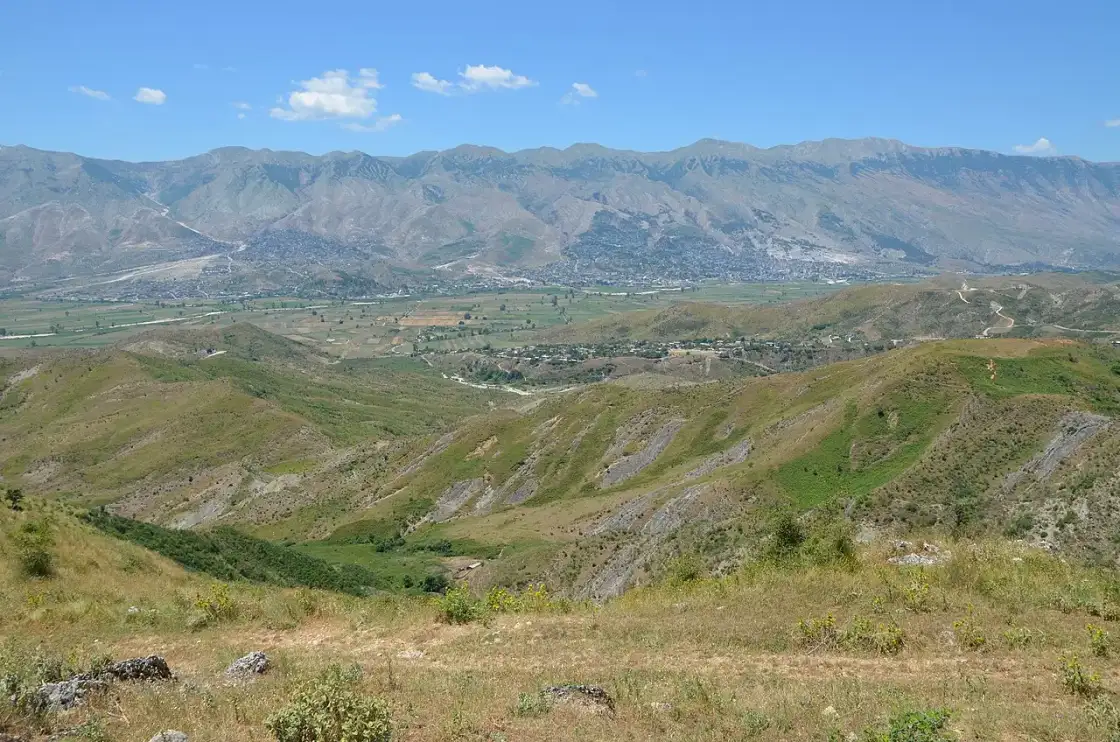
That long timetable is also why a same-day return from Tirana makes little sense. Do the sums: out on the 08:00, in at 12:31; back on the 17:00, in Tirana at 21:28. That’s nine timetabled hours on a coach for four and a half in a steep town. Stretch it to the 05:00 out and the 18:30 back and you do get nine hours in town, but you leave the terminal before dawn and roll back in at 22:58.
Getting to the terminal, and from the airport
The terminal is provisional: Tirana Parking, the municipal parking company, runs it beside the Casa Italia overpass where Rruga Kastriotët turns off for Kamza, and files Gjirokastër among its southern lines (Terminali Jugor). A taxi from Skanderbeg Square takes about 13 minutes outside rush hour; ask for “Terminali Jug-Veri, Casa Italia”.
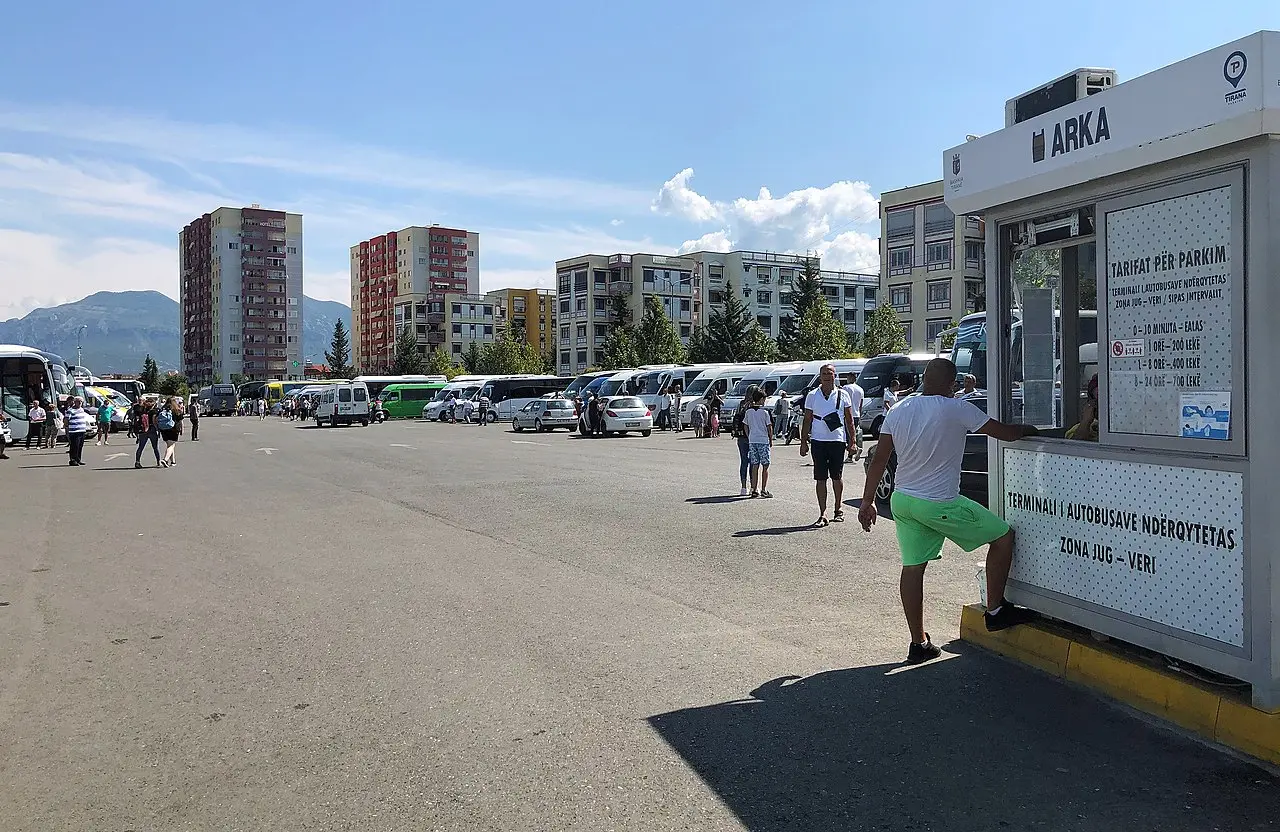
There’s no licensed coach from the airport itself. The airport’s hourly shuttle (07:00 to 18:00, 300 lek, 20 to 30 minutes) runs to this terminal, so land by early afternoon and the 15:30 or the 17:00 is within reach.
The fare: 1,200 lek, cash to the conductor
Both companies’ listings on the Visit Gjirokastra portal, run by the region’s tourism association, gave 1,200 lek one way in either direction when we checked on 23 September 2026. That’s roughly €13 (about $15) at the Bank of Albania’s rate on the same day. It’s the figure Gjirokastër’s drivers said they’d move to in March 2022, when fuel prices spiked, Ora News reported. The listings carry no date, though, and at least one line has gone up since fuel prices rose in spring 2026: Librazhd to Tirana, from 500 to 700 lek in April. Carry a bit more than 1,200 in small notes.
You pay on board, in cash, and lek is the safe bet; confirm the fare with the conductor at the door. Tirka 2000’s listing also shows a 2,000-lek round trip from the Gjirokastër end. Card payment on an Albanian intercity coach isn’t something to count on. For how tickets work on other Albanian routes, see how to get around Albania.
Getting off below the old town
The coaches stop on Bulevardi 18 Shtatori in the lower, newer part of Gjirokastër, not at the castle gate. The Old Bazaar is about 1.5 km away on foot, and it’s a climb, on cobbles once you reach the old quarter. After four-plus hours on a coach, with a bag, that’s the moment most people give up and take a taxi. Argjiro’s office is by the river bridge (Ura e Lumit), which is handy for booking the way back.
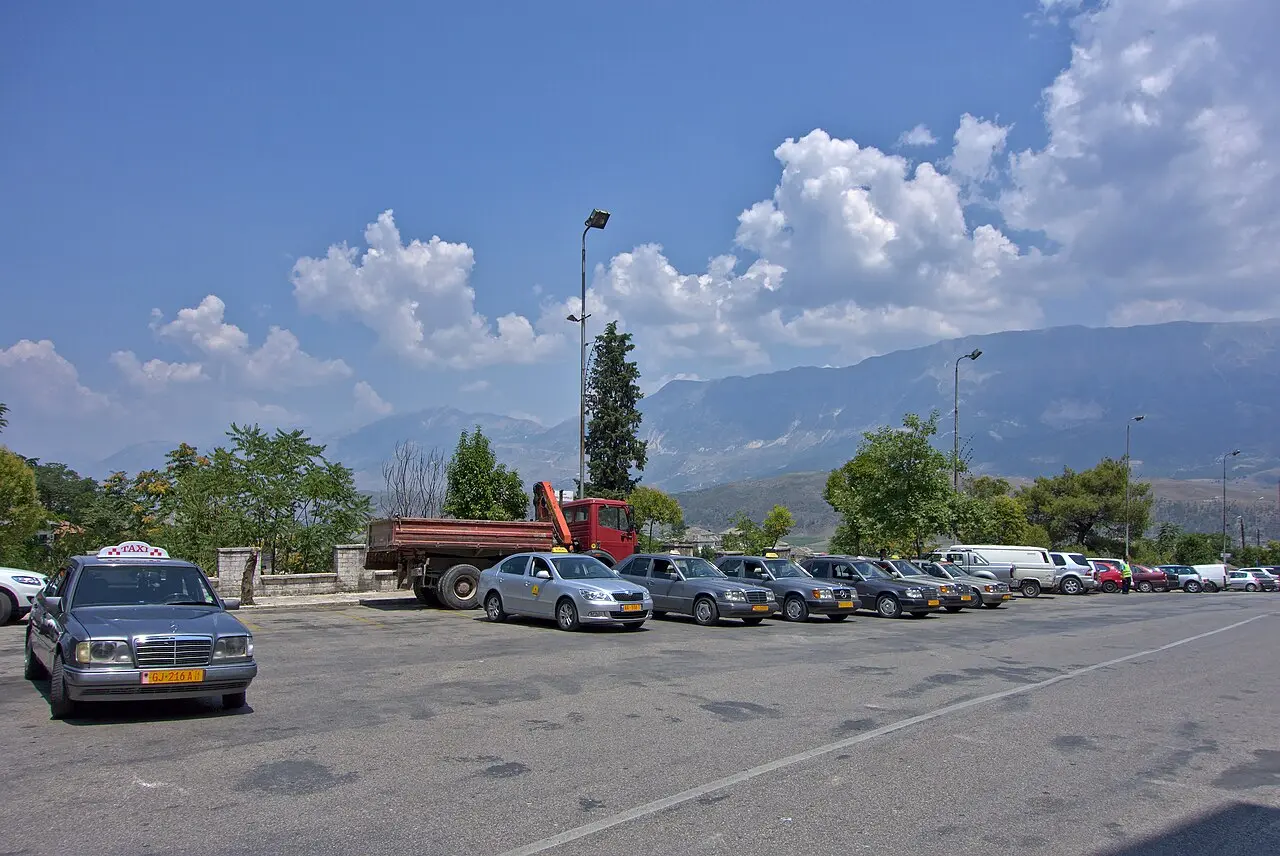
If your guesthouse is in the old town, ask whether it’ll meet the coach. Once you’re up, the castle, the bazaar and the tower houses are close enough to walk, and our Gjirokastër travel guide covers what’s worth your time.
Driving the inland road yourself
A rental car turns the same corridor into a drive of about three and a half hours before stops, south through Fier and Tepelenë and up the Drino valley. The road is the easy part. What’s hard is the old town at the far end, where the lanes are steep, cobbled and one-way, so leave the car at your guesthouse or a lower-town lot and walk.
For the town alone the coach wins: 1,200 lek against a day’s hire, fuel and a parking space in a town of steep one-way lanes. Hire when Gjirokastër is one night on a longer southern loop with the Blue Eye, Saranda and the Riviera; that circuit is mapped in the Southern Albania road trip. Rental terms, deposits and insurance are in how to rent a car in Albania.
A private car and driver
Door to door costs a lot more than the coach, and you pay it for a reason: a late flight, heavy bags, small children, or three or four people splitting one price. The cheapest car on Kiwitaxi on 23 September 2026 was from $172, a comfort sedan for four with three bags, with about 3 hours 20 minutes on the road; the seven-seat minibus was $573. From the airport the same sedan started at $165, which suits a morning landing heading straight south.
Stay the night, then go south or back
Gjirokastër rewards one night at least: dusk on the slate roofs, an early walk before the day-trip groups arrive from Saranda, then a coach north or a hop south. If you’re carrying on, Saranda is only an hour away by the register’s timetable, with six departures a day between Argjiro and Trans-Butrinti, and Argjiro lists that leg at 400 lek. For Berat, Argjiro’s 08:30 (1,000 lek on its listing) is the sure coach; the register also licenses Nikjorg at 13:45 and 16:00, but Nikjorg neither prints nor sells those runs, so ask at the terminal the day before and plan on the 08:30 if they aren’t running.
If you’re still planning the trip down, the 08:00 or 09:00 coach from Tirana at 1,200 lek is hard to beat. Flying in by early afternoon, ride the shuttle to the terminal and take the 15:30 or the 17:00. Four of you with bags, or a late landing? Price a private car from the airport, from $165 on Kiwitaxi.
Where to sleep is sorted in where to stay in Gjirokastër; if Berat is still in the running, Berat vs Gjirokastër makes the case for each, and the coast is in Tirana to Saranda.
Photos
Read also

Transport · 12 min read
Tirana to Athens: Bus, Flights & the Overland Option
Updated · October 5, 2026Tirana to Athens by bus: 04:00, 15:00 and 17:00 daily, €45 one way and 12-14 hours via Kakavia, or four direct flights a day. Checked 6 Oct 2026.

Transport · 9 min read
Tirana to Podgorica: Bus, Border & Onward to Kotor
Updated · October 5, 2026Tirana to Podgorica: about 160 km and 3.5-4 hours by direct bus via the Hani i Hotit border, two daily lines, then on to Kotor. Times checked 3 Oct 2026.

Transport · 10 min read
Butrint Day Trip from Corfu: Ferry + Site in One Day
Updated · October 4, 2026Butrint from Corfu in a day: a 30-45 min boat to Saranda, 18 km by road, a 1,000-lek ticket. Which boats work in October, November and winter.

Transport · 14 min read
Albania Border Crossings by Car: Queues, Docs & Green Card
Verified · October 2, 2026Albania's 13 customs road crossings: which stay open all night, when queues build, Green Card rules by plate, Kosovo's €15 insurance and EES into Greece.