Apollonia Archaeological Park: Ancient Ruins Near Fier
Apollonia near Fier is one of Albania's great ancient cities: a landmark temple facade, an odeon and a monastery museum. How to visit and what to see.
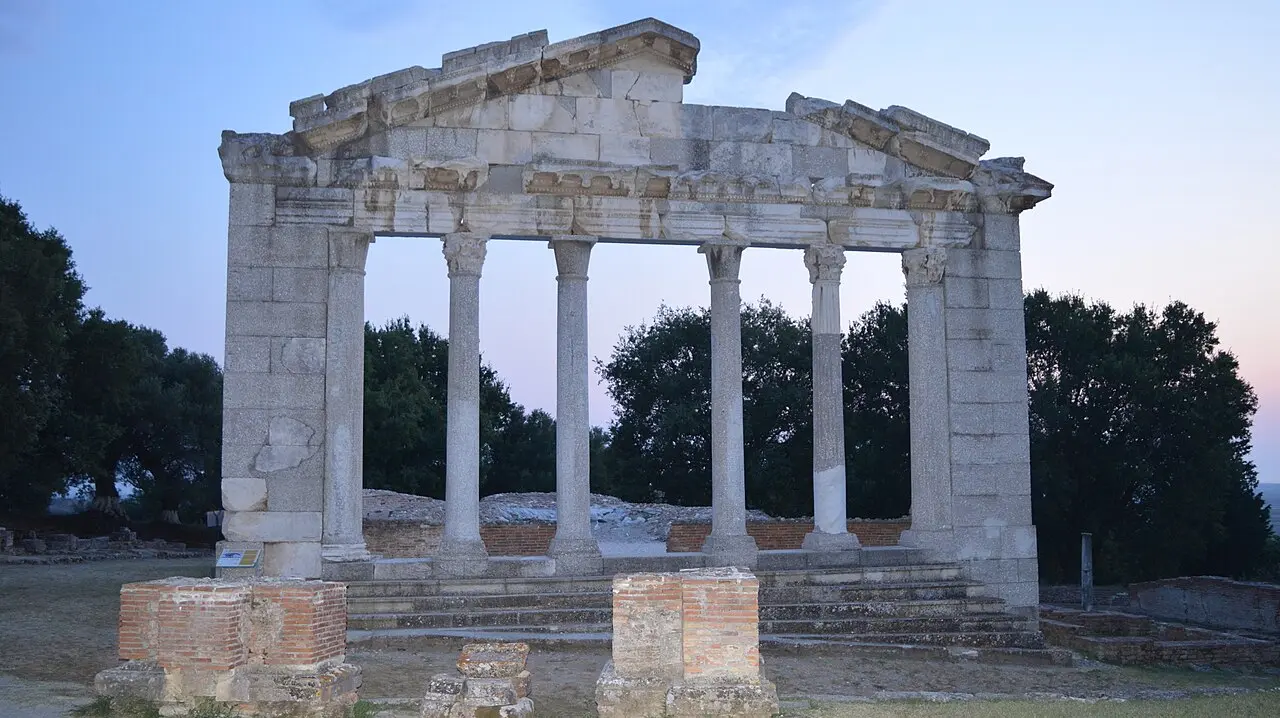
Apollonia (Apolonia) is a huge ancient city on a hill above the Myzeqe plain, about 12 km west of Fier in southern Albania. It was once one of the biggest and richest Greek-Roman cities on this coast, and today it’s a quiet archaeological park where a landmark temple-like facade, an odeon, long stretches of wall and a red-domed medieval monastery sit among olive groves and grazing sheep. Unlike Butrint down in the far south, it stands right on the main road between Tirana and Vlora, which makes it one of the easiest big ruins in the country to fold into a drive.
The draw here’s as much the story as the stones. This quiet hillside is where an 18-year-old student named Octavian heard that his great-uncle Caesar had been murdered in Rome, and left to become Augustus, its first emperor. Walk in knowing a little of that history and the scattered ruins begin to read as a real city rather than a field; come in the cool of the day and sort out the short hop from Fier in advance, and Apollonia’s one of the easiest great ruins in the country to enjoy.
What is Apollonia?
Apollonia was a Greek colony founded around 588 BC by settlers from Corinth and Corfu, on land the local Illyrians already used. It grew into a major port and one of the most important cities of the ancient Adriatic, minting its own coins and trading grain and slaves. When Rome took over, Apollonia became a western starting point of the Via Egnatia, the great Roman road that ran east across the Balkans to Thessaloniki and on to Byzantium. In other words, this field was once a gateway between Italy and the East - that’s the scale of it.
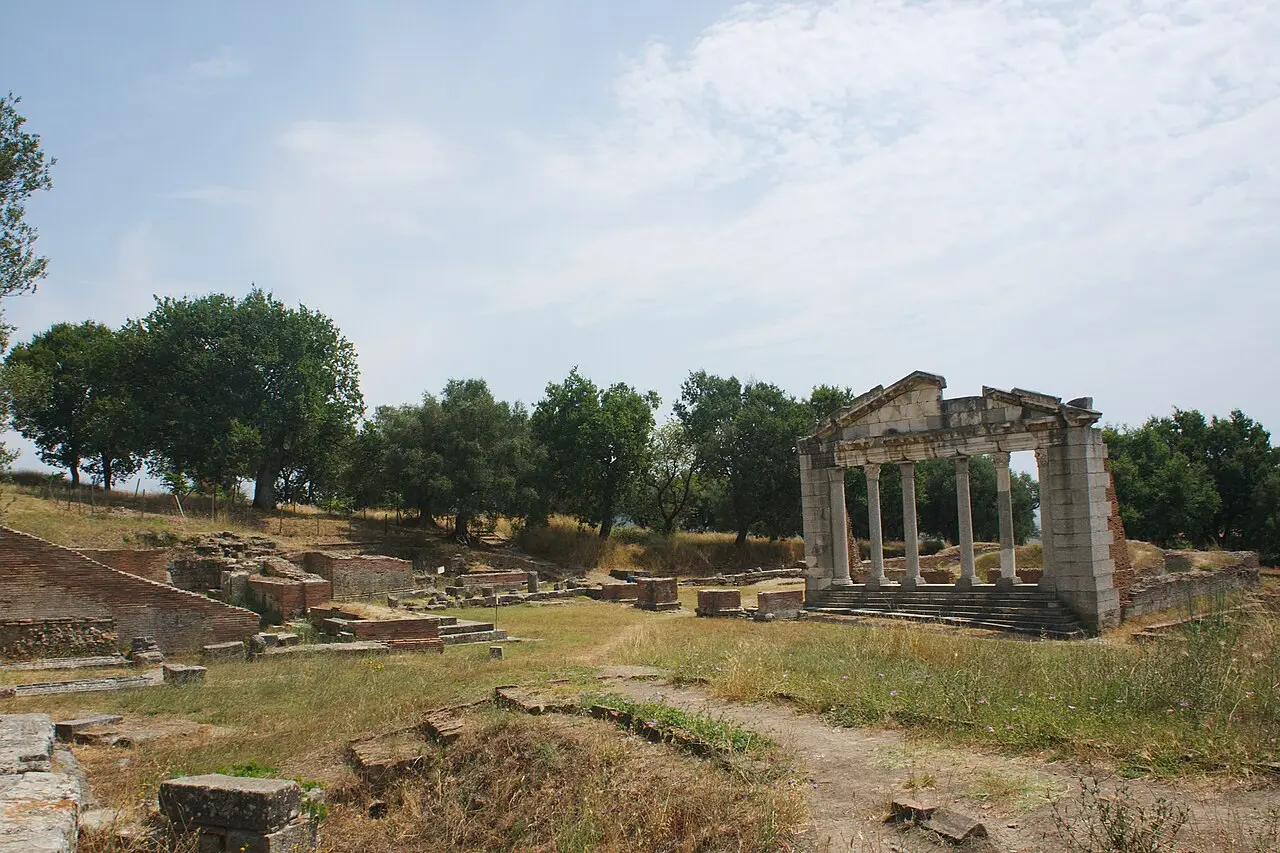
The site sits on a low range of hills above the flat farmland of Myzeqe, near the modern village of Pojan. The ancient city was vast, ringed by walls several kilometres long, and only a fraction of it has ever been dug. What you walk through is the excavated core, laid out over green slopes with the plain stretching away below, cypresses and olive trees between the stones, and you’ll often find barely another visitor in sight.
A short history: Greeks, Rome, and a future emperor
You’ll want Apollonia’s story before you walk it, because the stones make more sense once you do.
- Greek city (from around 588 BC). The Corinthian colony, first called Gylakeia after its founder Gylax and then renamed for the god Apollo, prospered for centuries as a trading port and a seat of learning.
- Roman colony. After Rome absorbed the region, Apollonia became a celebrated centre of Greek philosophy and rhetoric, the kind of place wealthy Romans sent their sons to study. Cicero called it magna urbs et gravis, “a great and dignified city.”
- Octavian’s moment. In 44 BC an 18-year-old Gaius Octavius was studying here when word arrived that his great-uncle Julius Caesar had been assassinated in Rome. He sailed home to claim his inheritance, and went on to become Augustus, Rome’s first emperor. The news that changed the ancient world reached him on this hillside.
- The slow end. The city’s luck ran out with its harbour. In the 3rd century AD an earthquake shifted the course of the Vjosa river (the ancient Aoös), the port silted up, and the low ground turned to malarial marsh. Apollonia was largely abandoned by the 4th century, its people drifting away toward what’s now Vlora.
By the time French and Albanian archaeologists went to work in the 20th century, most of the city lay buried under fields, which is exactly why so much survived to be uncovered.
What to see at Apollonia
There’s no long loop to march here as at Butrint; the excavated monuments cluster fairly close together, and you can see the highlights in an unhurried hour or so.
The Monument of Agonothetes
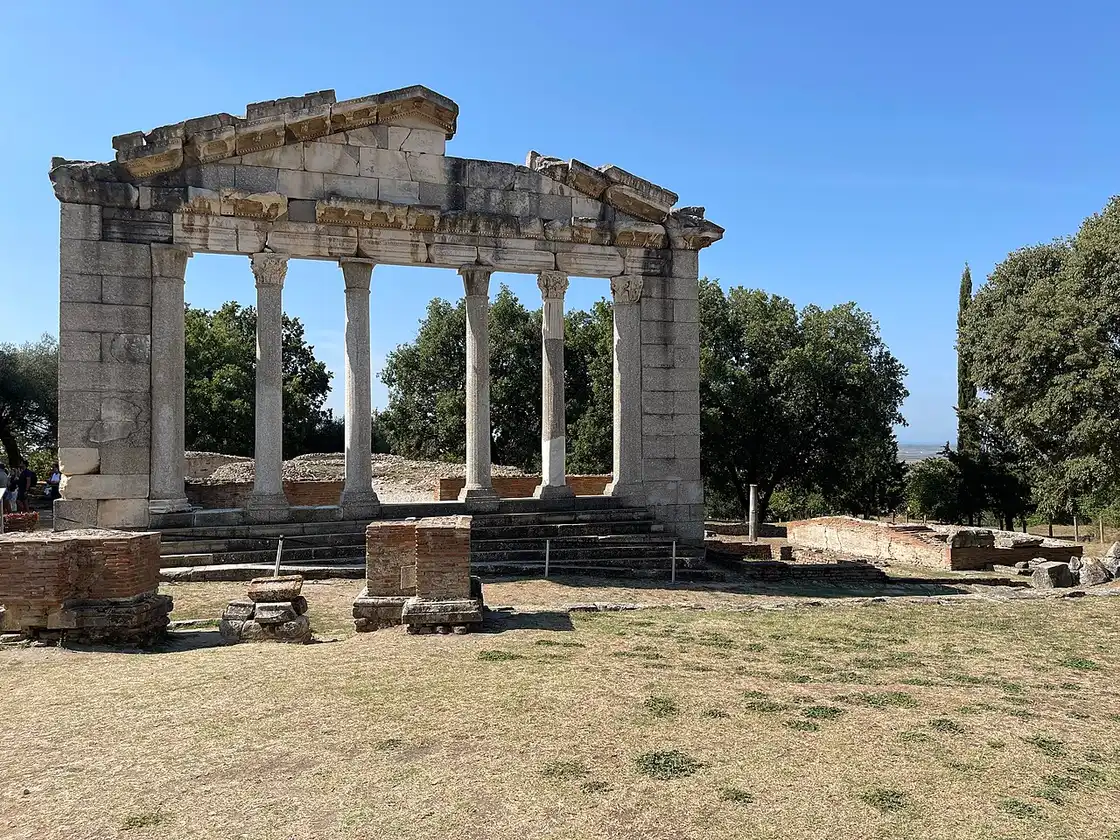
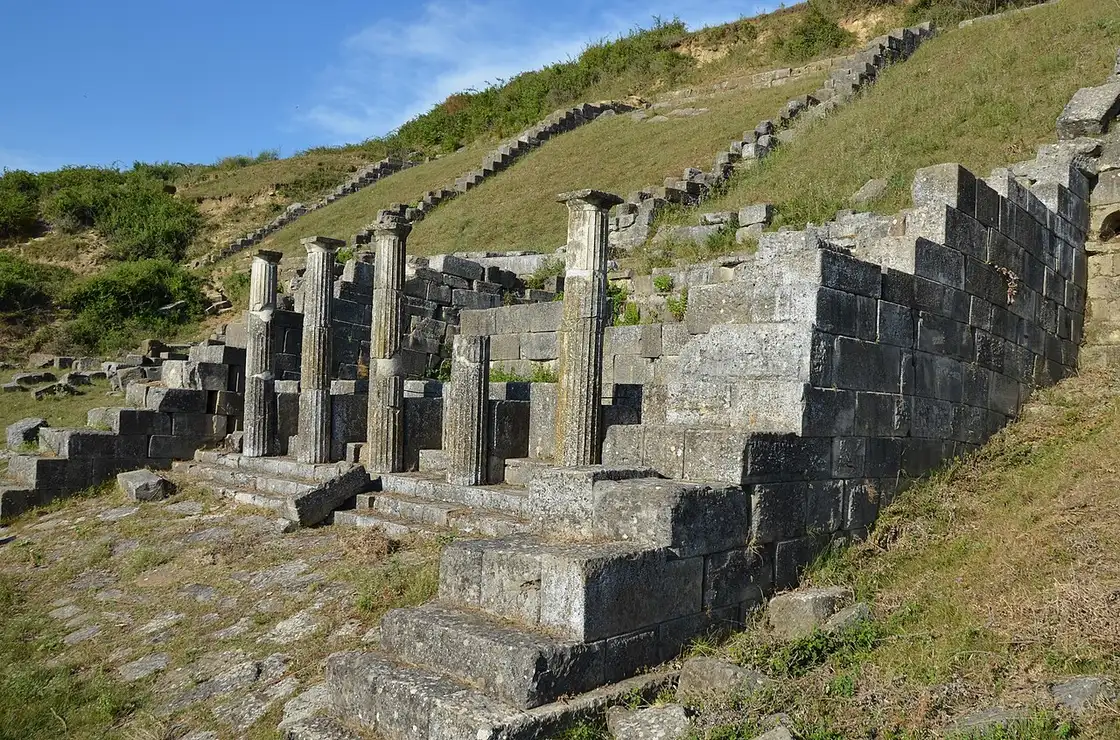
The showpiece, and the image on every postcard, is the Monument of Agonothetes, a 2nd-century-BC civic building whose front row of columns and carved pediment were re-erected by archaeologists. It looks like a temple, and almost everyone calls it one, but it was really a monumental administrative building tied to the city’s public games. Standing under its restored facade, with the pediment framed against the sky - that’s the single best moment on the site.
The odeon, bouleuterion and library
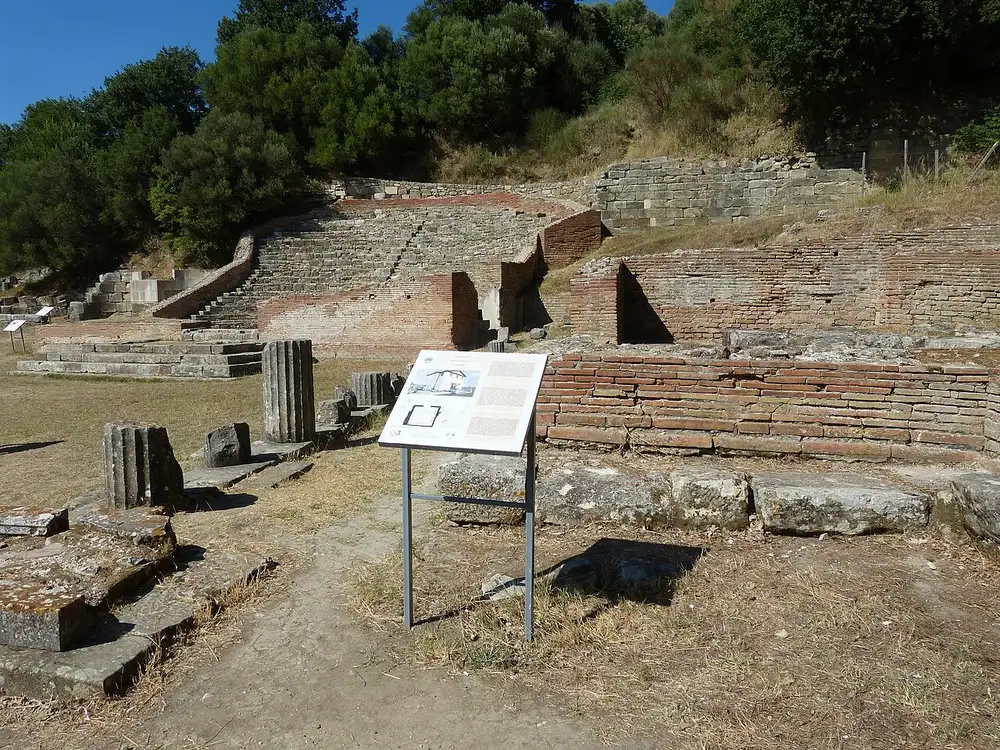
Just below and around the monument lie the civic buildings that made Apollonia a proper city - don’t rush past them. The small odeon, a half-bowl of brick and stone seating tucked into the slope, hosted music and recitals; nearby stood the bouleuterion (council house) and the library, the study rooms where those Roman students came to learn. The brickwork you see threaded through the grass is mostly Roman, laid over the earlier Greek foundations.
The nymphaeum, walls and temple
Downhill from the centre are the remains of a large nymphaeum, the monumental fountain that fed the city’s water supply, along with a portico and the stumps of a Temple of Artemis (a Greek temple from the 6th century BC was identified here in 2006). Follow the ground higher and you trace the line of the ancient city walls, with the whole Myzeqe plain and its patchwork of fields opening up below. These outer stretches are where you’ll feel the true scale of the place: the excavated buildings are a small island in a much larger buried city.
The monastery and the museum
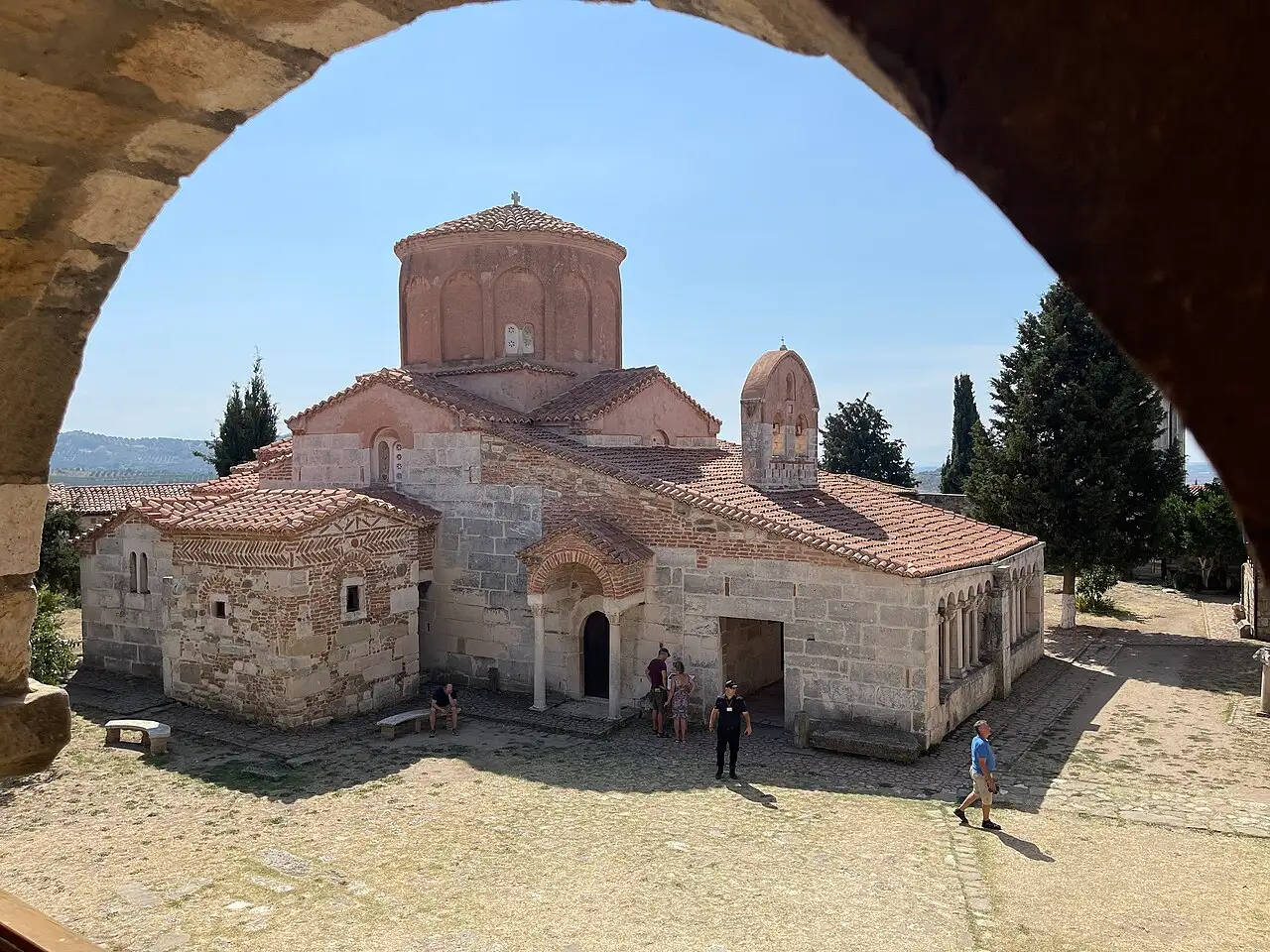
The most complete building at Apollonia isn’t ancient at all. In the 13th and 14th centuries, Byzantine monks built the Monastery of St Mary (Shën Mëri) right among the ruins, reusing old columns and blocks. Its red-domed church of the Dormition still stands, wrapped by a shady stone cloister, and the monastery buildings now house the Archaeological Museum of Apollonia, first opened in 1958 and reopened in 2011 after a long closure. Inside are statues, inscriptions, pottery and coins pulled from the digs, and the cool arcaded courtyard is the one patch of real shade on the whole hill, which you’ll be grateful for in July.
How to get to Apollonia
Apollonia sits just outside the village of Pojan, roughly 12 km west of Fier. Fier is the hinge: it’s a major stop on the main road down the country, so almost any southbound trip passes within a short hop of the ruins.
| Route | Roughly | Notes |
|---|---|---|
| Fier -> Apollonia | ~12 km / 20 min | The nearest town; take a taxi from the centre if you don’t have a car. |
| Tirana -> Apollonia | ~115 km / 2 h | South on the SH4 through Fier, then west to Pojan. |
| Vlora -> Apollonia | ~40 km / 45 min | An easy half-day from the coast. |
| Berat -> Apollonia | ~70 km / 1.5 h | Pairs well with a Berat old-town day. |
The honest catch is the last 12 km. There’s no direct bus to the gate, so without your own car the practical plan is a bus or furgon to Fier, then a taxi out to Pojan and back (agree a price and a wait, or a pickup time). If you’re driving, Apollonia is an easy detour off the main road, and our guide to renting a car in Albania covers the paperwork and the insurance excess that catches people out. A guided day trip that bundles the driving and a guide is the low-stress option, since the ruins aren’t heavily labelled. Based at the port further north, Apollonia is also one of the classic day trips from Durres.
Tickets, hours and how long to allow
Apollonia is a staffed archaeological park with a ticket gate. The official 2026 rate card puts a full adult ticket at 600 lek, with 500 lek for groups of 12 or more, 180 lek for anyone aged 12 to 18 or holding a student card, and free entry under 12; disabled visitors and pensioners pay half price, and booking online shaves the individual rate to 500 lek. Hours split into three seasons: 09:00 to 19:00 every day from May through October (last entry 18:45), 09:00 to 17:00 daily in March and April, and 09:00 to 16:00 Tuesday to Sunday from November to February, closed Mondays in winter. Park prices and hours do shift, so treat those as a guide and confirm the current rate at the gate.
A few things that don’t change:
- Allow about 1.5 to 2 hours for the ruins plus the museum without rushing.
- Bring water, a hat and sun cover. The hill is open and there’s very little shade outside the monastery cloister; midday in summer is brutal.
- Carry cash in lek for the ticket and the taxi; don’t count on cards at the gate.
- A guide or the museum labels help. The monuments aren’t always well signed, so a guided tour or a good read beforehand pays off.
- Watch for free days. The park waives entry on the last Sunday of the month from October to May, plus 18 April, 18 and 21 May, 29 September and 28-29 November.
Combining Apollonia with Berat, Vlora or the coast
Because it sits on the main southern road, Apollonia slots neatly into a bigger day rather than demanding one of its own.
- With Berat. The UNESCO “city of a thousand windows” is about 70 km east, so a classic pairing is the ruins in the cooler morning and Berat’s old town in the afternoon. See our Berat travel guide.
- With Vlora and the Riviera. Apollonia is a natural warm-up on the way south; from Fier it’s under an hour to the coast at Vlora, the gateway to the Albanian Riviera. Our Vlora city guide covers the beaches and the drive on over the Llogara Pass from there.
- On a road trip. If you’re looping the country by car, the ruins are a fixed stop on our Albania road-trip itinerary, and Fier sits right on the Tirana to Vlora route.
Is Apollonia worth visiting?
If you like your ruins grand and polished, Apollonia will feel raw: much of it’s stumps, trenches and half-buried walls, and it asks you to picture the city rather than have it handed to you. But that’s also the appeal. You get a genuinely important ancient city, a beautiful re-erected facade, a red-domed monastery and a real museum, usually in near-total quiet, for the price of a coffee and a short taxi ride. For anyone driving between Tirana and the south, it’s the most rewarding hour you can spend off the main road, and a reminder that Albania’s history runs a lot deeper than its beaches.
Read also
- The other great ancient city: Butrint National Park in the far south.
- The nearest UNESCO old town: our Berat travel guide.
- On to the coast: the Albanian Riviera and the Vlora city guide.
- Driving there yourself: how to rent a car in Albania.
- Fit it into a loop: the Albania road-trip itinerary.
Photos
On the map
The map loads on click - to keep the page lightweight.
The map didn’t load. Check your connection and refresh the page.
Distance ≈115 km · ~2 h by road
- Tirana ≈115 km · ~2 h by road South on the SH4 to Fier, then about 12 km west to Pojan. Easy to fold into a Tirana-Vlora or Tirana-Berat drive.
Read also

What to see · 9 min read
Bovilla Lake Tirana: Gamti Viewpoint & Road Tips
Updated · September 1, 2026Bovilla Lake near Tirana: 20 km by road, gravel last stretch, Gamti balcony hike, drinking-water rules, and when a guided tour beats self-drive.

What to see · 11 min read
Valbona Valley: Guesthouses, Walks & Alpine Road
Updated · August 30, 2026Valbona Valley in the Albanian Alps: arrival via Fierza and Bajram Curri, guesthouses, short walks, and the paved Alpine road.

What to see · 9 min read
Shala River Day Trip: Albania's Alpine 'Thailand'
Updated · August 27, 2026Shala River day trip in 2026: turquoise water in the Albanian Alps, boat times from Koman Lake, prices, what to pack, and how it differs from the ferry.

What to see · 10 min read
Saranda Boat Trips 2026: Kakome, Krorez & Mirror Beach
Updated · September 17, 2026Saranda boat trips to Kakome, Krorez and Mirror Beach: EUR 25-35 north and from EUR 100 south at the operators we checked, plus where boats leave.